
Family cycle
Trigger, intake, compress, test, expand, return, align, shape, receipt, propagate, then settle or retest.
Notes · Graphite Engine
The Graphite engine keeps family assignment open. The nine integrity families share a common center. Any family can implicate adjacent families. No family is permanently first or last. The twelve nouns are intake classes available to every family, not twelve extra families.
Why a finding gets attacked before it settles
Boeing’s 737 MAX certification treated a finding — that a single angle-of-attack sensor was an acceptable input to a flight-authority system — as settled without the adversarial testing that would have surfaced the single-point-of-failure and the recovery path. Two crashes and 346 lives later, the cost of letting a finding settle unattacked was not theoretical.
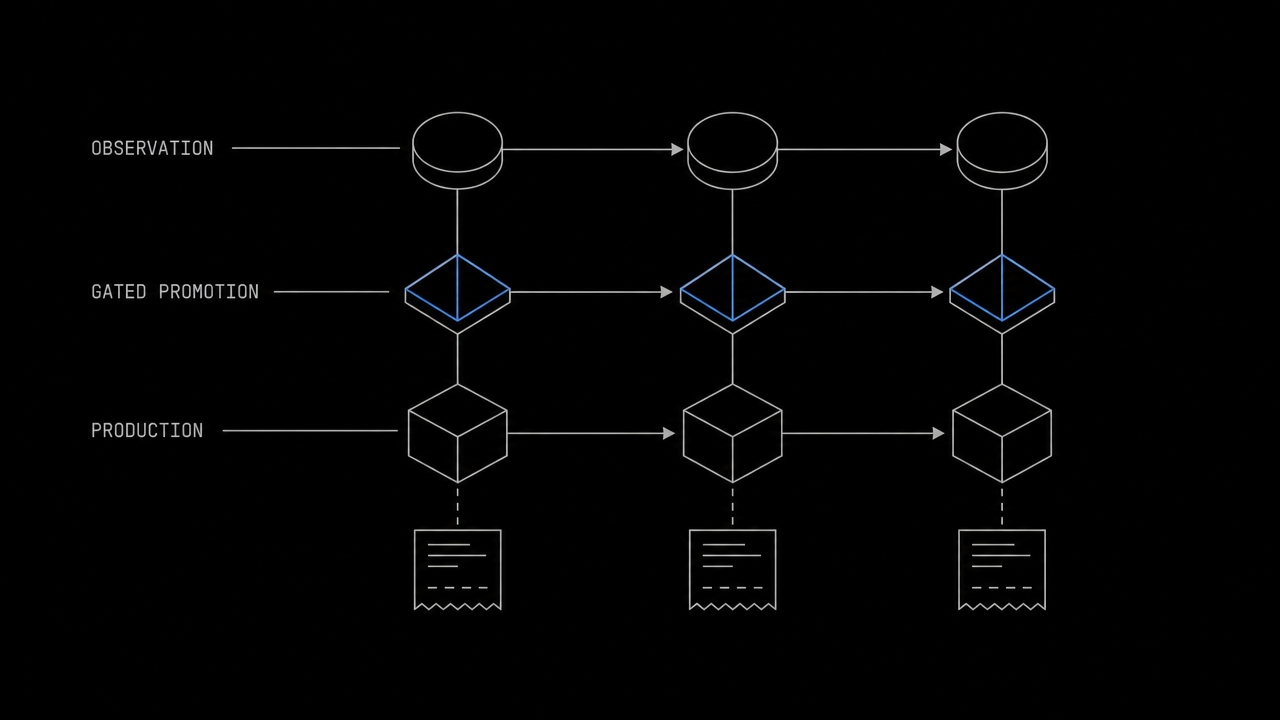
The Graphite engine makes testing a required stage, not an optional one. A finding enters a family, is compressed through fractionalization, then tested adversarially — corroboration, contradiction search, reproduction, dependency retrace, stale-generation checks. Only surviving material is shaped, and the shaping arbiter cannot create evidence or invent truth. If evidence is insufficient, the finding holds.
Canonical architecture is assembled incrementally: no brick without a course, no course without anchorage, no architecture without receipts.
Trigger, intake, compress, test, expand, return, align, shape, receipt, propagate, then settle or retest.
Stable: receipt-bound, no active trigger. Watch: aging evidence or an open condition. Active: a material delta in flight. Critical: contradiction, authority breach or an unproven high-impact transition. Activity is not confidence.
A family may extend temporary probes into public surfaces, repositories, tests and traces. Probes collect, verify, corroborate or contradict. They do not hold authority.
Accept, generalize, subsume, reject, hold, split or retest. Shape, align, deduplicate, fence observation from authority, propagate adjacent impact, record proof debt, then receipt.
Evidence realization can trigger identity and freshness. Policy coverage can trigger cutover and recovery. Stale observation can block publication. No family cools in isolation.
No delta, corroboration, a subsumed finding, a new watch trigger, a revised invariant, a new test obligation, a runtime block, a cutover block, a publication candidate, a correction.
The engine does not become permanently finished. It becomes stable enough to idle: instrumented families, active watch triggers, aging evidence, and the ability to retest the correct family without reopening the whole architecture.
Boundary
Fractionalization asks whether a claim is safe to use. The taxonomy says what kind of thing it is. A Graphite family says which integrity law owns it. The shaping arbiter says whether it is formed well enough to settle. A runtime test and receipt say whether the settled architecture is actually true.